

How To Set Up A Bench Plane
Seven Steps to Top Handplane Performanceby J. Norman ReidDelaplane, VA | ||
You've just purchased that new smoothing plane you've had your eye on for and then long. Or you've lovingly brought an older Stanley Hand Plane to bright and shiny condition. And now you're ready to put a fine finish on a treasured piece of wood. But is your plane ready to make the wispy shavings you're hoping for? What can you practise to gear up your airplane for the all-time results? Here are vii steps to get peak performance from your mitt planes.
Sharpen and Hone the Bract
Your aeroplane volition never work equally it should without a well-sharpened and honed bract. Premium planes will cutting reasonably well right out of the box, but to perform their best even they need a little preparation. Upkeep planes and survivors from an before era require even more than attention.
First, flatten and polish the back of the blade to remove any machining marks. Work your blade back and along across the sharpening stones, starting with your coarsest grit and working up through the grits until all scratches have been removed and you attain a mirror polish. This task only needs to be done in one case, merely even on premium planes information technology's a necessary stride. Don't get overboard; you are really simply concerned with the final one-half inch or so of the blade's back. The rest of the bract volition never touch the wood and can be safely ignored.
Side by side plough your attention to the bevel. The primary bevel on nearly plane blades should be 25°. Exceptions are blades set at a higher cutting angle for hard grain. If your bevel is not at the correct bending, the edge is not foursquare to the sides, or the cut border is nicked you'll demand to regrind it. This can be done on a grinder—an eight inch tiresome-speed grinder is all-time for this work, a water-cooled, large wheel grinder fifty-fifty better—but good results can be achieved by working the blade on PSA sandpaper attached to a dead flat surface. I start with lxxx dust paper and work up to 120 grit. Once the bevel is shaped to the proper angle, it, too, will demand to be polished mirror smooth by working your fashion through the grits of any stone or sandpaper method you use. While some woodworkers are able to go good results by manus holding their blades, I highly recommend a honing guide to produce consequent, repeatable results.
If your restored airplane has a bract that'due south in very rough condition, yous may find it easier to buy an aftermarket replacement blade. Not only will you start with a blade that's in premium condition, but it will be made of a more durable modern steel than was bachelor when the older planes were originally fabricated.
One time you take a high polish on your primary bevel, you lot want to establish a secondary or micro bevel most 2–five° college than the primary bevel. This will demand to be done on all blades, as fifty-fifty premium blades practice non come up with a micro bevel. Once again, starting time with your coarsest stone and stroke until you've established a sparse line evenly across the tip of the blade. So proceed to the next higher grit. Finish past giving it a mirror polish with your highest stone. Do a conscientious chore here; information technology's the micro bevel that meets the wood and produces those fine shavings.

Finally, to get the sharpest edge, employ David Charlesworth's ruler flim-flam to put a very slight back bevel on the blade. Place a sparse ruler lengthwise on the rear border of your rock. Then, lay the blade on the stone bevel side upwards with the cut edge off the far edge of the stone. While making back-and-forth sideways motions, carefully pull the blade onto the stone, then push it off again, repeating the process upward to 10 times. Do this using each of your stones, working to your highest grit. The result—a high shine on the extreme tip of the bract back that gives the sharpest edge. In one case done, this step demand not be repeated, though y'all may wish to refresh the back bevel with your finest rock each time y'all re-hone your microbevel.
Now that your blade is sharpened and honed to perfection, you will normally but demand to refresh the micro bevel on your finest rock from time to time to proceed information technology in top cut condition.
Upgrading Your Plane Bract
If your blade is in bad shape—either badly nicked or rusted—y'all might be better off installing a new replacement bract. Several manufacturers offering replacement blades in a variety of widths to fit older Stanleys, Records and other brands. Some blades are as much as 25 percent thicker than the original blades and use modernistic steels, including both A2 and 01 steel. Replacement chipbreakers are also bachelor.
Thicker blades reduce the likelihood of chatter and offer greater stability, but they may require adjustments to the frog or even the size of the mouth opening to arrange the greater thickness. Available blades vary in thickness, so take this into business relationship when purchasing. A thickness of .095 inches or less will likely work in most older planes.
Replacement chipbreakers in particular may be thicker than the original parts and may not fit older planes. Check with the manufacturer before ordering. Highland Woodworking carries Stanley replacement blades and chipbreakers.
Set the Mouth Opening
While the lion'southward share of attention goes to getting a keen edge on the bract, several other steps volition help you get the best from your plane. Ane is adjusting the mouth opening. On a bevel down airplane, this is achieved by moving the frog forward or astern until the opening is slightly wider than the thickness of the desired shaving. For smoothing planes, very fine shavings are the goal and then you will want to set a very narrow gap. The opening tin be wider for jointers and wider still for jack planes set up to take thick shavings when roughing out a lath.

Prepare the frog with the blade in place and slightly projected. On planes based on the Stanley Boulder model, which includes Lie-Nielsen planes, adjust the opening past loosening the two screws on either side of the depth aligning cycle. Then accelerate or retract the frog as necessary by turning the large screw located between the ii locking screws. In one case the frog is adjusted, loosely tighten the locking screws, remove the blade and sight down the frog to the mouth to confirm that the frog is perfectly foursquare to the mouth. Then tighten the locking screws alternately and gradually until tight. Don't over tighten them to avert stripping the threads.

The more mutual Bailey-mode planes have a slightly unlike screw system—ii locking screws located under the blade-chipbreaker assembly and an adjusting spiral at the rear of the frog. This means you may have to insert and remove the bract and chipbreaker assembly several times until you become the oral fissure ready the way you lot want it. Otherwise, the adjustment process is the same as for Bedrock-style planes.

Some newer planes—including block planes and other bevel-up planes—are built with adjustable mouths. Ordinarily the mouth is loosened by turning a lever at the base of the toe, then sliding the oral fissure assembly forward or backward to obtain the desired opening.
Adjust the Chipbreaker
The chipbreaker on a bevel downward plane should also be set so the altitude from the blade edge is slightly more than the width of the shavings y'all intend to make. For smoothing almost hardwoods, 1/32 inch is good, though you may want to gear up it at 1/64 inch for difficult woods prone to tearout. For softwoods, i/16 inch may be more advisable. The distance volition vary for individual planes gear up up to achieve unlike results. Bevel up planes, of class, have no chipbreakers and need no such aligning.

Adjust the Cap Iron Pressure
The cap iron should hold the blade and flake breaker firmly to eliminate churr merely not and then tightly that the depth adjuster can't exist easily moved with two fingers. With the lever loosened, tighten the spiral until it holds the blade and bit billow snugly in place, then snap the lever down and test the ease of adjustment. One time yous've achieved the correct amount of pressure, exit the spiral alone and remove the iron by raising the lever.

Set up the Depth Adjuster
Now we come to the business end of the adjustments, where the metallic meets the wood. On almost planes, you lot turn the depth adjustment wheel clockwise to deepen the cut and counterclockwise to retract it. Nevertheless, there are exceptions. I recently came upon an old Crusader where the depth adjuster was turned in the contrary direction, so check your plane to come across which rule applies.

Unfortunately, because of the unavoidable condition of backfire—backlog play in the bike aligning—setting the blade depth then it does not slip in place requires a trivial more technique. The rule is to finish all depth adjustments with a downward, normally clockwise, move of the wheel. Failing to keep downwardly pressure leaves the blade in a loose status that lets it skid, and you can rapidly lose the adjustment y'all just carefully set.
Thus, if the blade is gear up too deep, back information technology off past turning the wheel counterclockwise until the blade is fully retracted. So make small down (normally clockwise) adjustments, testing after each move, until you get the right depth. If y'all detect you demand a more than shallow set, repeat the unabridged process past backing the blade out and and so deepening the cut past small degrees.
Lateral Adjustments
The rule of thumb here is to slide the lateral adjustment lever toward the side of the blade that is cutting too deeply. You can test the balance of the blade depth by sighting downwards the sole and looking for the black line that shows the presence of the blade. Or you can look directly into the rima oris from the lesser of the airplane to judge whether the blade is the same distance from the mouth edge on both sides. A third method is to take a sparse wood fleck and stroke it gently on each side of the blade, paying attention to the size of each shaving produced as well every bit the sound as the chip passes over the cut edge. The acid examination, however, is to make a cutting on a scrap lath to see if yous get shavings of equal thickness from each side of the blade. On a flat lath, you would expect to get a full-width shaving of compatible thickness. If the shaving is light on ane side or missing altogether, move the lever slightly to the side that is cutting heaviest and retest. A serial of pocket-sized, successive adjustments will usually produce better results than making wider swings in the hope of hitting the correct setting in one movement. Often, moving the aligning lever affects the overall depth of cutting, and so be prepared for follow-up depth adjustments.

Cambered blades, considering the bract corners are curved, are easier to put into balance. This is one reason why they are recommended for most users, especially those new to using hand planes (see below).
To Camber or Not to Camber—That is the Question
Plane blades can exist cambered or kept directly, according to the user'southward preference and skill level. The temptation—particularly for new users—is to leave the bract edge only every bit information technology comes out of the box: direct. Simply information technology is precisely new users who tin can benefit the almost from a cambered blade. Why? Because a cambered blade is more forgiving when it is not precisely set to equal depth on both edges. A bract that'southward not counterbalanced is very likely to dig more deeply into the woods on one side than the other, leaving "tracking" marks on the surface.
To camber a blade, separate the bract edge into fifths and with your index finger on each fifth of the blade take progressively more strokes on your stones equally yous work further abroad from the middle. By taking slightly more metal from the edges than the middle, you'll create a slight curvature to the cut border. Count the strokes and apply the aforementioned number on each side and with each of your stones on both the primary and micro bevels. For best results, record your strokes in your shop notebook and so you lot can echo the same process each time you re-strop the bract. Smoothing planes can be cambered very slightly; blades on planes intended for heavier stock removal can exist given greater curvature.
Lubrication
Lubricating the airplane's sole makes a surprising difference in the ease with which the aeroplane glides over your workpiece. I generally make a serial of X marks on the sole of my plane using a stick of beeswax. How oftentimes should y'all do this? The simple answer is, whenever you feel the resistance begin to build against the smooth movement of your airplane. That can range from every dozen or and so strokes to every ii or three boards. Information technology's a thing of personal preference and whether you're working a rough or smooth surface.
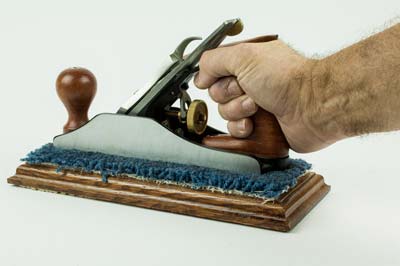
In improver to beeswax, methane series or mutton tallow work well. Or, y'all tin can make a plane oiler by gluing a slice of discarded carpet to a wood block and spraying it lightly with Camellia or jojoba oil. Drag the plane backwards over the carpet to coat it lightly with oil. None of these lubricants will interfere with your terminate.
The author is a woodworker, author and photographer living in Delaplane, Virginia, in the foothills of the Blue Ridge Mountains with his married woman, four cats and a woodshop full of ability and hand tools. He can exist reached past e-mail at nreid@fcc.net.
Source: https://www.highlandwoodworking.com/woodworking-tips-1305may/peakhandplane.html
0 Response to "How To Set Up A Bench Plane"
Post a Comment